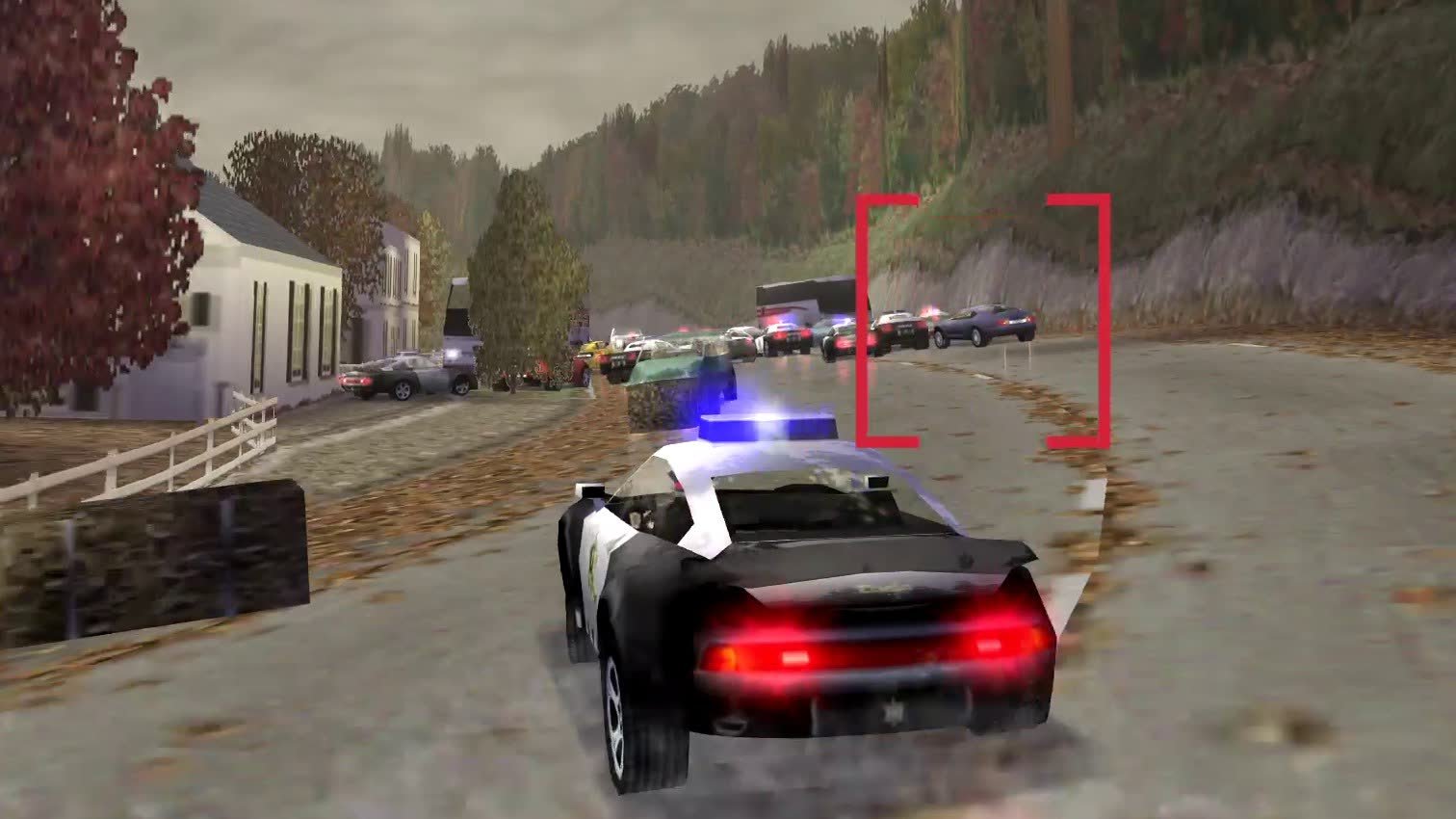
A Game That Hasn't Been Forgotten
The original Need for Speed: High Stakes was released in 1999. By modern standards, its capabilities are quite modest: a small selection of cars, a limited number of tracks, relatively simple AI, and graphics designed for computers of the late 1990s.
But NFS4 has something that keeps people coming back even after all these years. Its unique atmosphere, familiar tracks, interesting damage system, Hot Pursuit mode, and a career that's still enjoyable to play.
And, of course, an enormous collection of community-created content.
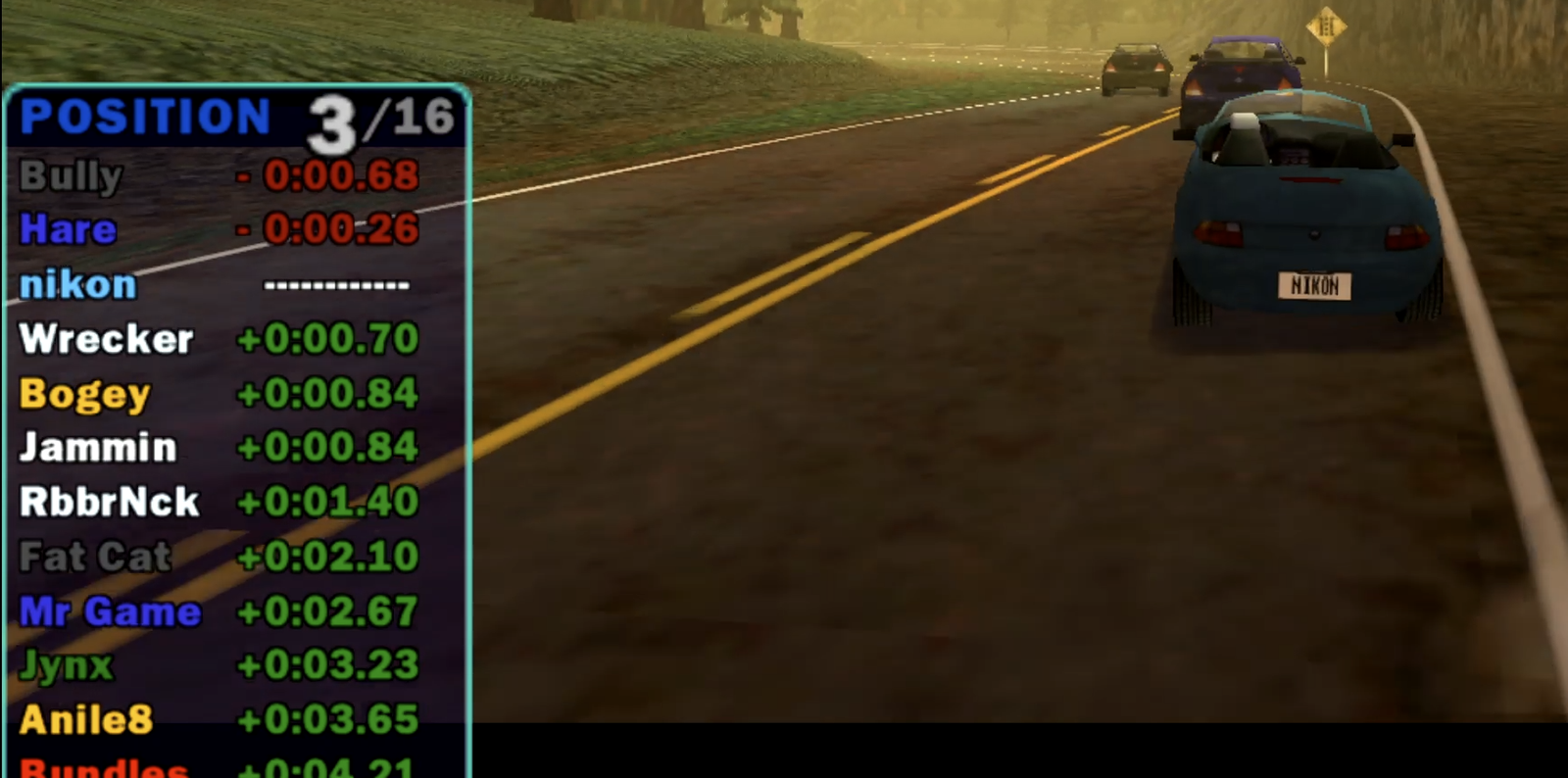
One of my early experiments, which could be considered a predecessor of n4patch: a career tournament with 16 cars instead of the usual number of participants.
Cars, Tracks, and the Community
Over the years, thousands of add-ons have been created for NFS4. Some have been almost forgotten, others are still being updated, and new projects continue to appear.
One of the main places to find all this content is NFSAddons.
Cars, tracks, textures, editors, and small fixes are still being published there. Among the active members of the community are Hommelwomb, JimDiabolo, EvoX, pete9516, and many others.
The work being done on the original tracks is particularly noticeable. Many are receiving higher-resolution textures, improved environments, and geometry fixes. The best remakes manage to preserve the game's recognizable style without turning it into something completely different.
Good examples include Celtic Ruins HD by Hommelwomb and Atlantica Revisited 2.0 by JimDiabolo and EvoX.
In May 2026, Hommelwomb also released the NFS4 All in One HD Mod Pack.
It's a fairly large collection that brings together around 50 cars, HD tracks, improved dashboards, career modifications, sound enhancements, and numerous contributions from other modders.
For someone looking to rediscover NFS4, collections like this can be a great starting point. However, there's also a downside: the more modifications included in a single installation, the harder it becomes to identify the cause of potential problems or add something of your own.
The Patches That Keep NFS4 Running
Before getting into the newer features, it's worth remembering a few projects without which modern NFS4 modding would look very different.
VEG Modern Patch
In 2016, VEG released the first version of NFS4 Modern Patch.
The patch made it possible to run the game without a traditional Windows registry-based installation, simplified moving the game between computers, and added support for cars with higher polygon counts.
These features may seem fairly ordinary today, but they were extremely useful for a game released in 1999.
However, NFS4 Modern Patch never received all the features VEG had previously implemented in his similar patch for NFS3. Full widescreen support, for example, remained on the roadmap.
The author eventually marked further development as suspended. The latest official version is still v0.1.0, released on May 11, 2016.
Nevertheless, VEG Modern Patch remains an important foundation for many modified NFS4 installations, including my work on n4patch.
In the future, I also plan to make n4patch compatible with the original, unmodified version 4.5 executable.
SilentPatch
In September 2023, Silent released a collection of fixes for several classic Need for Speed games, including High Stakes.
Unlike larger modifications, SilentPatch focuses primarily on fixing relatively small but annoying problems.
These include issues with high-polling-rate mice, input handling, certain aspects of CPU thread allocation, and incorrect Alt+F4 behavior.
There are also some small quality-of-life improvements, such as the ability to paste text using Ctrl+V.
Individually, these fixes might not seem revolutionary, but together they make the old game noticeably more pleasant to use.
SilentPatch can work alongside VEG Modern Patch, although compatibility with other modifications should be checked separately.
Vulkan: Another Step Toward Modern Graphics
One of the most interesting developments of 2026 was the release of Vulkan Thrash Driver by Ultra Jericho.
The original NFS4 uses its own THRASH graphics driver system. This new project implements that interface using Vulkan.
Rather than simply wrapping an old Direct3D or Glide API, it provides a separate implementation of the game's graphics driver.
The main goal is to preserve the original gameplay while making the game more comfortable to run on modern computers.
Some of the new renderer's features include:
- Vulkan support for modern graphics cards.
- Widescreen resolutions with FOV and HUD adjustments.
- High-frame-rate rendering.
- Up to 8x MSAA and 16x anisotropic filtering.
- Windowed and fullscreen modes.
- Fixes for Z-fighting and various graphical issues.
- Improved menu rendering and multi-monitor support.
What's particularly interesting is that increasing the rendering frame rate should not change the speed of the original physics simulation. This is especially important for NFS4, where simulation frequency and timing are closely tied to the game's behavior.
Following the initial September release, the author continued fixing issues. The October 15, 2026 update addressed performance, object rendering, rearview mirrors, controls, and replay behavior at high frame rates.
Download Vulkan Thrash Driver from NFSAddons
n4patch: What I'm Working On at nfs4.com
Now let's move on to the project I've been developing myself.
Throughout 2026, I've gradually been building a modular patching system for High Stakes here at nfs4.com, called n4patch.
Initially, I just wanted to fix a few annoying limitations of the original game and add some features I'd always felt were missing.
For example, displaying the best lap time directly during a race, or allowing players to restart a race in Career mode, even after finishing.
But it quickly became clear that there were many more interesting possibilities.
And along with them came the discovery of numerous engine limitations.
Why a Modular System?
When working with the NFS4 executable, sooner or later you run into an unpleasant problem: different patches may modify the same sections of code.
The more fixes you add, the harder it becomes to keep track of their compatibility.
Besides, directly modifying the executable is probably one of the least convenient ways to distribute patches. It works well enough for a one-time fix to some basic functionality, but it comes with too many limitations.
So instead of creating yet another collection of modified EXE files, I decided to switch to separate patch modules.
I already had part of such a system for a telemetry collection module. I just couldn't bring myself to embed all that code directly into the EXE. :)
That's how the n4patch loader came about.
It connects to the game through a DLL and applies modifications directly in memory. The nfs4.exe file itself remains unchanged on disk.
Each fix can be packaged as a separate .n4p file. The loader checks compatibility, detects overlapping modifications, and records the results in a log.
Players can choose which features they want to enable.
More importantly, this approach makes it possible to gradually extend the engine without turning every update into another complete game build.
Learn more about n4patch Loader
Race Limit: When 16 Cars Are No Longer Enough
One of my first major experiments involved increasing the number of race participants.
Initially, I added the ability to create races with 16 competing cars. This already changed the gameplay quite noticeably, adding a bit of chaos at the start and throughout the race.
But I kept running into the same dilemma: should I use 16 racers and lose traffic entirely? Or perhaps 6 racers, 8 police cars, and just 2 traffic vehicles?
For some races, I really wanted traffic to be present regardless of the number of competitors.
That led to another question: why not expand the vehicle limits for the police as well?
In the original game, the numbers of racers, police cars, and traffic vehicles are restricted by fixed-size memory structures. Many of these limitations are also interconnected.
Simply changing one number isn't enough. You have to find every place where the game uses the corresponding arrays and modify the checks, collision handling, interface, and other systems.
Gradually, what started as a patch for 16 participants evolved into Race Limit.
Today, it supports up to 16 racers and 16 police cars. Regular traffic has its own separate limit of up to 16 vehicles.
This means that, theoretically, up to 48 vehicles can be present on the track at the same time.
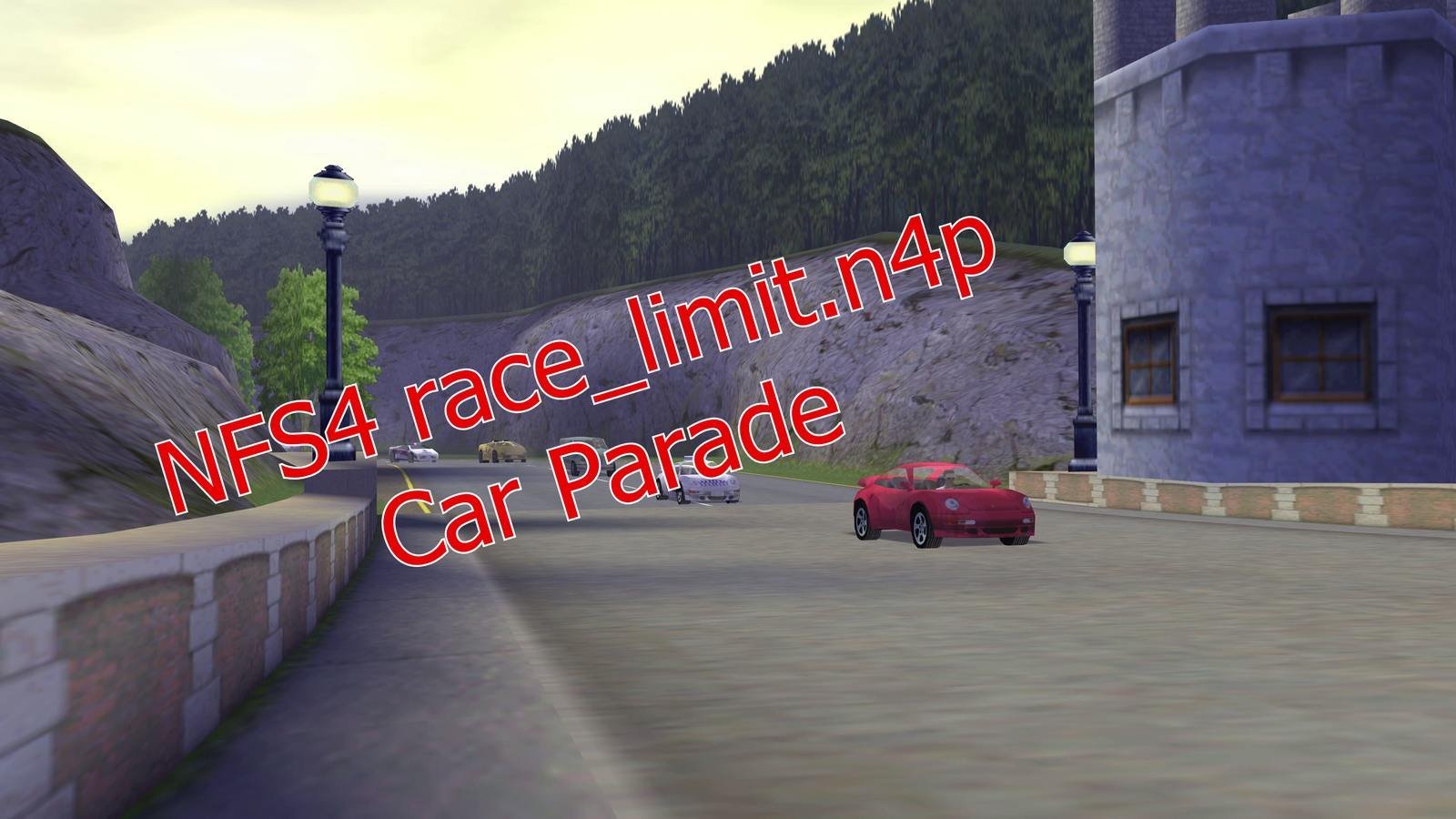
Race Limit: increasing the number of racers, police cars, and traffic vehicles. A frame from the demonstration video.
The difference is particularly noticeable in Hot Pursuit.
When a large number of racers and police cars appear on the track, a familiar pursuit turns into a rather chaotic competition. Cars constantly collide and get in each other's way, while the police sometimes barely have time to organize a proper chase.
This also revealed something unexpected: more cars don't necessarily make a race more interesting.
For certain modes, having just 4–6 racers, more complex rules, and more active police may actually work better.
Custom Race: Let Players Decide What Their Race Will Be Like
While working on the vehicle limits, I was also tackling another problem.
All right, the game can now support more cars. But how do you give players a convenient way to control all these new possibilities?
That's how Custom Race appeared.
It's a new mode added directly to the Single Player Arcade menu, allowing players to configure many aspects of a race.
You can choose not only the track, weather, or number of laps, but also the participants, their cars, colors, AI skill levels, and aggression.
The traditional separation between racers and police is no longer mandatory, either. There's nothing stopping you from putting a police officer behind the wheel of a regular sports car, or using a police vehicle as a racing car.

One of the Custom Race screens, showing car, color, name, and AI behavior settings.
You can also create custom Tournaments and Knockouts, change the points system, and configure how many participants are eliminated.
I've paid particular attention to random generation.
The idea isn't simply to select a random track or car. Instead, players can define a set of rules within which the game generates a race automatically.
For example, you can allow only certain car classes or manufacturers, exclude specific models, set ranges for AI parameters, and get completely different races using the same restrictions.
This is especially useful for players who already know the standard NFS4 competitions inside out and want something less predictable.
Hot Pursuit Experiments
Hot Pursuit is currently one of the most interesting areas of Custom Race development.
Alongside the classic pursuit mode, Get Away and Time Trap are also available.
I'm also experimenting with a new mode called Distance Run.
In Distance Run, the racer's objective is to cover a specified distance without getting arrested. Unlike Get Away, where the goal is to survive for a certain amount of time, the important thing here is the distance traveled.
It's still an experimental feature.
Modes like this require not only new gameplay rules but also changes to the HUD.
That's one of the reasons why Custom Race remains an actively developing project.
Video: Hot Pursuit Distance Run
Track Limit: No More Replacing Original Tracks
Another long-standing limitation of NFS4 is the number of available tracks.
Over the years, an enormous number of custom tracks have been created. But installing them usually means replacing one of the existing tracks.
That's inconvenient, especially if you want to build a large collection.
The result was Track Limit Expansion.
It increases the number of supported tracks from 19 to 255.

Additional tracks integrated into the standard NFS4 interface.
At first glance, the task seems simple: increase the size of an array and change the number of items in the menu.
In practice, it turned out to be much more interesting.
The original game stores a lot of additional information for each track, including selection images, loading screens, 2D maps, 3D track previews, records, and various settings.
That's why I had to add automatic generation of missing resources directly from the track data.
For many custom tracks, the patch can now automatically generate a map, 3D preview, Vidwall image, and loading screen. This only happens when the track itself doesn't already provide the required resources.
I also added a separate record storage system that distinguishes between weather conditions, time of day, and driving direction.
Of course, not everything works perfectly yet. Compatibility with older replay formats and interactions between additional tracks and other modules remain particularly challenging.
But the main goal has already been achieved: additional tracks can now be used through the standard NFS4 interface without replacing the originals.
FRD Limit: What Happens When We Remove the Old Limits?
Another interesting experiment involves the FRD track format.
The original NFS4 uses fixed-size arrays for certain track elements.
For example, the game was designed around limits of 300 track blocks and 128 dynamic physics objects.
Dynamic objects aren't just decorative models. They're objects that can move, fall, and interact with vehicles.
To test whether these limitations could be expanded, I created a special test track filled with boxes.
More information about the FRD Limit research
ReplayView: Finally, Better Replay Controls
The replay system in the original NFS4 is quite limited.
You can't move the camera freely around the track, and there's no rewind functionality.
For simply watching a race, that may be enough. But if you want to record a nice video, examine an interesting moment, or explore your own track, the available controls are clearly insufficient.
That's why I created ReplayView.

ReplayView makes it possible to watch races from unusual angles and take control of the camera.
The module now allows you to move the camera freely using the mouse and keyboard, attach it to vehicles, save custom camera positions, and rewind or fast-forward replays.
Implementing rewind turned out to be particularly interesting.
The original engine wasn't designed to run its simulation backward. So I had to save snapshots of the game state and restore them during rewind.
It's more complicated than it sounds, because you need to account not only for the cars but also for objects, effects, and various internal systems.
Some visual and sound effects may still not be restored completely.
Nevertheless, ReplayView is already much more convenient than the original replay system and makes it possible to create videos that would previously have been difficult or impossible to record.
Small Fixes Matter Too
Not every modification needs to be a major one.
Sometimes fixing a single old bug is enough to make a custom track properly playable.
For example, on some steep uphill sections, a car may suddenly lose speed as though it has hit an invisible wall.
I investigated this problem and found an error in the game's track-boundary prediction logic.
My own Go implementation of the original game's physics engine was particularly helpful during this investigation. It allowed me to generate graphs illustrating the problem and eventually find a fairly elegant solution.
That's how Uphill Fix came about.
Another example involves incorrect geometry data in custom tracks.
Sometimes the game works perfectly until the rearview mirror is enabled. Once it's turned on, graphical glitches or crashes may occur.
The cause can be incorrect temporary buffer sizes or invalid vertex references.
I created Track FRD Fix to address problems like these.
Such fixes may not be as noticeable as 16-car races or entirely new game modes, but they're important nonetheless.
Tools for Creating Mods
Alongside gameplay patches, modding tools continue to evolve.
One of the best-known tools is T3ED, the track editor for NFS3 and NFS4.
In January 2026, JimDiabolo and other contributors released version 4.5.0 (436), adding new features for working with objects and textures.
I've also been trying to develop some tools of my own at nfs4.com.
nfs4viv
While experimenting with increasing the car limits, I needed a convenient way to inspect car.viv data.
It was particularly important to find duplicate serial numbers and modify car parameters without manually editing binary structures.
That's how nfs4viv, a utility written in Go, came about.
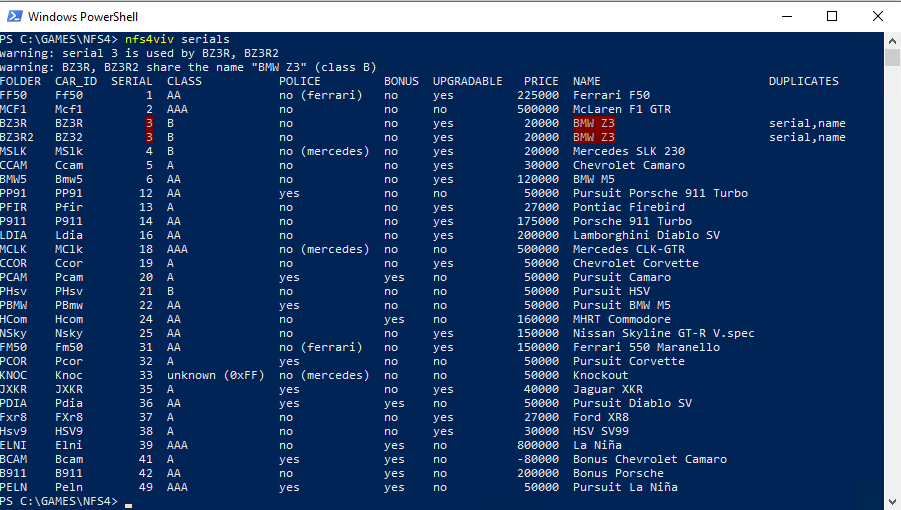
An example of analyzing car archives and detecting duplicate serial numbers with nfs4viv.
The utility can inspect archives, check serial numbers, modify FEDATA entries for multiple languages, and export information to JSON.
For now, it's primarily a tool for developers and mod pack creators.
But it's already useful for investigating car resources and preparing new modifications.
Career Editor
Another interesting tool is the online Career Editor, which allows you to modify the structure of career competitions.
You can create custom tournaments, change race sequences, and edit career parameters.
This is a separate area of development that could eventually complement Custom Race and other engine modifications quite well.
What About Multiplayer?
The multiplayer side of NFS4 hasn't been forgotten either.
Ultra Jericho continues working on the NFS4 Online project.
In August 2026, beta versions v0.6.1 and v0.6.2 were released, primarily focusing on improving network stability.
The fixes addressed malformed packet handling, server operation, cleanup of inactive connections, and certain issues when exiting the game.
This is an important area of development, since NFS4's original networking architecture was designed more than a quarter of a century ago and isn't particularly well suited to modern conditions.
However, it's still too early to say that all multiplayer problems have been solved. A lot more testing is needed across different computers and network connections.
What Problems Remain?
Despite all these achievements, the original NFS4 still contains a huge number of limitations.
Some are fairly obvious: fixed-size arrays for cars, tracks, or textures.
Others only become apparent after modifying a particular part of the engine.
For example, increasing the number of cars may reveal additional limitations in the collision system. Adding more tracks requires changes not only to the menus but also to records, resources, police and traffic settings, and replays.
Increasing the number of dynamic objects, meanwhile, forces you to investigate hidden dependencies between physics, rendering, and internal memory structures.
And that's probably the most interesting part of the work.
Quite often, fixing one problem leads to the discovery of several new ones.
One of my near-term plans is to investigate and expand the limitations of the car engine simulation, such as the 10,000 RPM engine speed limit, the number of gears, and other related restrictions.
Performance
Even when a limitation is removed, that doesn't mean the original game can efficiently handle the new possibilities.
For example, thousands of dynamic objects or a large number of cars can put a considerable load on the CPU.
Additional optimizations are needed, preferably without changing the behavior of the original physics. In fact, I'd consider preserving that behavior practically essential.
Patch Compatibility
Different modifications may use similar mechanisms to hook into and modify the game's code.
As a result, compatibility cannot be taken for granted.
With n4patch, I'm trying to address this through its modular architecture and compatibility checks during loading. But as new features are added, the number of possible combinations continues to grow.
Formats and Architecture
NFS4 remains a 32-bit game, with all the corresponding address-space limitations.
Many of its file formats use small integer fields and fixed-size tables.
Expanding them often requires modifications to several subsystems at once.
Completely eliminating these limitations would be impossible without a major overhaul of the engine.
Where Is All This Heading?
Looking back at the history of NFS4 modding, there's an interesting shift in how the game has evolved.
For many years, the main way to improve the game was to add new cars, tracks, and textures.
Later came compatibility patches and graphics wrappers, making it easier to play on modern computers.
Now, more and more attention is being paid to the inner workings of the game itself.
We're gradually learning how to change the engine's limitations, introduce new gameplay rules, and expand existing systems.
Some of the areas I'd like to explore further include increasing the number of available cars, expanding Hot Pursuit, improving AI behavior, adding more replay features, and optimizing the handling of complex tracks.
Some of these ideas are already being experimented with. Others are still just plans.
And I don't want to promise too much.
Working with a game engine from 1999 can be unpredictable. Sometimes a small fix takes only a few hours, while tracking down the cause of a single bug can take days.
But the results of the past few months show that many of NFS4's limitations aren't insurmountable.
Final Thoughts
Perhaps the most surprising thing about Need for Speed: High Stakes is that, 27 years after its release, it hasn't simply continued to run.
It continues to evolve.
Modders create new cars and tracks, improve the graphics, fix old bugs, and find ways to use the original engine in situations that once seemed impossible.
And every project contributes something to that progress.
VEG Modern Patch helped keep the game running on modern computers. SilentPatch fixed a number of annoying issues. Vulkan Thrash Driver demonstrated new possibilities for the graphics system. And countless creators of custom content continue to bring new things into the game.
Here at nfs4.com, I'm trying to make my own contribution by exploring and expanding the capabilities of the engine itself.
Not everything works on the first attempt. Some experiments end in crashes, while others require a complete redesign of the original approach.
But that's exactly what makes the work interesting.
It seems NFS4 still has a few surprises left for us, even after more than a quarter of a century.
And I hope there are many more interesting updates ahead.
Комментарии
Свернуть ветку от Herms за 2026-11-16 13:04
Truly remarkable year for nfs4 modding.
For those who are not able to use the new Vulkan driver, there is a project by Neth called HSframefix on github that I recommend. It offers some of the same features but is compatible with older GPUs that don't utilise Vulkan. It also restores some menu special effects that were only available with nglide.
Thanks for the additional info!
I've heard of HSframefix and even downloaded it, but I haven't had a chance to test it yet.
Войдите, чтобы оставить комментарий и оценить. Войти